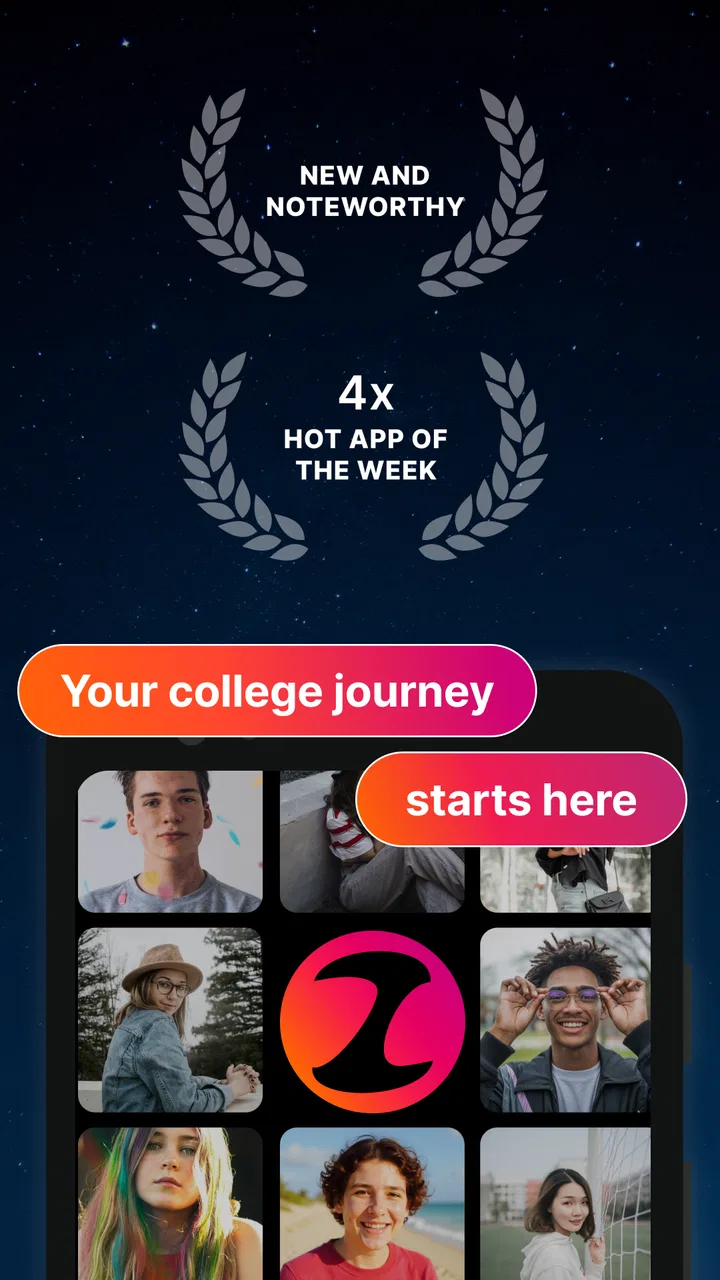
ZeeMee
- 4.5
- Rating
- 100.00K
- Installs
- Free
- Price

 Analysis by App-foxy
I approached ZeeMee as a social app built around the college experience rather than as another general-purpose feed. That distinction matters. Its appeal is strongest when you are trying to understand a campus community, meet people with a shared academic destination, or make the transition from “I am considering this school” to “I actually feel connected to it.” I found the idea more focused than opening a broad social network and hoping the right conversation appears.
The app is free, aimed at a Teen audience, and developed by ZeeMee. It has reached over 100 thousand installs, with an average rating of 4.5 from around 2.6 thousand ratings and 372 written reviews. Those figures suggest a healthy level of interest, although they do not remove the need to think carefully about what you share in any student-centered social space.
What I like most is the intended setting: college decisions and campus life create natural reasons to talk. What makes me more cautious is that those conversations can involve personal details, location-related context, school plans, and identity. My experience with the app therefore comes down to two questions: does it help me form useful connections, and does it give me enough control to decide how visible I want to be?
You May Also Like

 Blood Strike: 2.5 Anniversary
Blood Strike’s Loadouts Turn Every Drop Into a Tactical Gamble
A close look at Blood Strike’s custom loadouts: how fast access to signature weapons reshapes its battle royale rhythm, rewards preparation, and narrows the gap between fights.

 Pandora - Music & Podcasts
Pandora’s Music Is Easy to Start, but Harder to Recover
Pandora’s strength is its low-effort path from a seed to a station. Its weak spot is how much confidence it asks you to place in connection, setup, and quiet recovery.

 8 Ball Pool
 Is Built on Rivalries, Rematches, and Routine
A close look at the rivalries, rematches, shared routines, and unanswered safety questions that turn a quick pool match into a persistent mobile community.

 Samsung Music
’s Quiet Strength Is Playing What You Already Own
Its reach comes less from spectacle than from dependable access to a personal library. That simplicity is both the app’s strongest retention engine and its ceiling.

 AccuWeather: Weather Radar
AccuWeather Review: A Quick, Clear Forecast for Everyday Decisions
For everyday plans, the best forecast is the one you can understand quickly. AccuWeather makes rain timing, radar, and local conditions easy to act on, with a few trade-offs.

 Hill Climb Racing
Why Hill Climb Racing Still Turns Crashes Into One More Run
A tiny car, a bumpy hill and one more upgrade: Hill Climb Racing keeps resurfacing because its simple chaos makes every near-miss feel personal.
More From Our News Desk
View All News


How the college-focused community feels in practice
The first useful mental model is to treat ZeeMee as a starting point for college conversations, not a replacement for every social platform you already use. A general network may be larger, but its audience is mixed and its discussions are often noisy. Here, the college context gives interactions a clearer purpose. A question about residence, orientation, student life, or choosing between schools has a better chance of finding people who understand why the question matters.
I can imagine using it during the uncertain period after applying to college. Instead of relying only on official pages, I would want to hear how other prospective students are thinking, what concerns they have, and whether the social atmosphere feels welcoming. That does not make any individual comment an official answer, but it can add a human layer that admissions material cannot provide.
The app is also suited to students who already know where they are going and want to reduce the awkwardness of arriving alone. A short conversation before the first day can make a large campus feel less anonymous. The important expectation is to view those early connections as introductions, not instant friendships. A college-oriented community can open a door, but the quality of the relationship still depends on how respectfully and carefully people interact.
For parents or guardians, the Teen content rating is a useful signal about the intended audience, but it should not be treated as a promise that every interaction will suit every young person. Social apps always depend on user behavior. I would encourage a younger user to discuss privacy choices before posting identifiable information, and I would make sure they know how to disengage from a conversation that feels pressuring or uncomfortable.
A realistic way I would use it before moving
Imagine that I have accepted an offer but do not know anyone at the school. I would begin by reading rather than immediately publishing a detailed profile. I would look for recurring topics, notice whether replies are constructive, and identify the kinds of questions people actually answer. After that, I might introduce myself with only broad information: the school I am considering or attending, an area of interest, and a low-risk question about settling in.
That sequence is more useful than trying to make a perfect introduction. It lets me judge the tone of the community before revealing much about myself. If I later decide to continue a conversation privately, I would keep the early exchange inside the app where possible and avoid sharing a home address, daily schedule, personal phone number, or travel plans. The best first step is observation, not oversharing.
A second practical use is comparing expectations. If several students raise the same concern, that may tell me what to investigate through official college channels. If opinions conflict, I would not treat the loudest response as the truth. I would use the conversation to create better questions for the school, not to replace formal guidance about housing, enrollment, finances, or safety.
Where it differs from familiar social alternatives
Compared with a broad social network, ZeeMee has a narrower reason to exist. That focus can reduce the effort required to find relevant conversations, especially when college is the subject occupying most of your attention. The trade-off is that a focused community may feel less useful once your immediate transition is over, or when you want content unrelated to student life.
Compared with messaging a friend group, it is better for meeting people outside your existing circle but less predictable in terms of closeness and trust. Compared with official college communication, it is more conversational and personal but less authoritative. I see it as a bridge between those two options: a place to discover questions, compare experiences, and begin social contact, while official sources remain the right destination for decisions with serious consequences.
Someone who wants a polished professional network, a private group chat, or a general entertainment feed may be happier elsewhere. ZeeMee makes the most sense when the college connection itself is the reason you are opening the app.
Trust, controls, and the moments that deserve care
I’d treat trust as an ongoing choice, not a box to tick during setup. Before becoming more active, I would decide which details genuinely help someone answer me and keep the rest private; that small habit makes it easier to participate without letting the excitement of a new campus connection set my boundaries.
What I look for before becoming active
Trust in a social app is not just about whether the interface feels friendly. I look at the choices presented during account setup, the visibility of anything I publish, and how easy it is to change my mind later. With a college-centered service, I would pay particular attention to whether my school affiliation, profile details, and conversations are visible more widely than I intended.
I would read each privacy and account prompt instead of tapping through automatically. If the app asks me to make a profile, I would choose the smallest amount of information needed to participate. A recognizable name or school connection may help people identify relevant peers, but that benefit has to be weighed against how easily a stranger could connect the profile to my offline life.
The developer is ZeeMee, and the current version is 6.0.3 for devices running Android 8.0 or later. That makes compatibility straightforward for many Android users, but I would still check the permissions shown on my own device rather than assuming every phone presents the same choices. Permission screens are the practical source of truth for what the installed app is requesting at that moment.
Permissions and data-sensitive situations
I would be especially deliberate when a social app asks for access that could reveal more than the conversation itself. Before granting any permission, I would ask whether it is necessary for the action I am trying to perform. If I only want to read discussions, I would not automatically approve access that appears unrelated to reading. If a feature genuinely needs a permission, I would consider granting it temporarily and reviewing the choice afterward through the phone’s settings.
This is not about assuming bad intent. It is about matching access to purpose. An app can be useful and still deserve careful boundaries. College-related posts can contain names, schedules, photos, locations, and hints about when someone will be away. Even a harmless-looking introduction can become sensitive when several small details are combined.
For that reason, I would avoid posting a complete routine, exact residence information, personal contact details, or documents that show identifying numbers. I would also be cautious about photographs containing badges, room numbers, car plates, or other background details. These are simple habits, but they matter more in a community where users may be trying to learn who will be on the same campus.
How I would keep control of my account
I would periodically revisit the account and device settings rather than treating privacy as a one-time decision. If I stop using the app after the college transition, I would look for the available sign-out, profile-editing, and account-management options and remove information I no longer want associated with the service. I would also review the app’s permissions from the operating system, because disabling access there is a useful independent control.
Notifications deserve attention too. A message preview on a locked screen can expose more personal context than intended. I would adjust notification visibility if conversations begin to include sensitive topics, and I would avoid using a shared device without checking whether the account remains signed in.
Another overlooked control is social pacing. I do not have to answer immediately, accept every request, or continue a conversation simply because it began politely. If someone pushes for private contact, asks for unusual personal details, or tries to move the interaction somewhere I do not trust, I would stop responding and use the app’s visible reporting or blocking choices if available on my screen. I would not negotiate with pressure.
What makes the experience valuable, and what creates friction
The strongest part of the concept is relevance. When I am thinking about college, a focused community can save time because the surrounding context is already understood. I do not need to explain why a campus question matters before asking it. That can make the first interaction less intimidating, particularly for students who do not have an established network.
The friction comes from the same focus. Conversations can be shaped by excitement, anxiety, rumors, or strong personal preferences. A confident answer may sound authoritative even when it is only one student’s experience. I would cross-check anything involving admissions, housing, payments, deadlines, health, or safety with the appropriate official source.
There is also a natural privacy trade-off: the more context I provide, the easier it may be for others to respond meaningfully, but the easier it may become to identify me. I would start with broad details and add context only when it clearly improves the conversation. That approach may make my profile less immediately engaging, but I prefer a slower, safer connection to a highly exposed one.
Who should try it, and who should skip it
I would recommend giving ZeeMee a look if you are preparing for college, newly connected to a campus, or hoping to find peers before a major transition. It is particularly appealing if the hardest part of the process is social uncertainty rather than finding another source of official information. The focused setting can help turn vague nervousness into specific conversations.
I would be more hesitant if you dislike public or semi-public social interaction, want strict separation between online and offline identity, or are looking for a mature professional network. I would also skip it if I expected the app to answer formal college questions with the authority of an admissions office. Its value is social context, not institutional certainty.
For a younger user, I would make the decision together with a trusted adult and establish boundaries before joining conversations. For an adult student returning to education, the audience and tone may or may not match what you want; the college focus remains relevant, but the community experience could feel oriented toward traditional student transitions.
My cautious verdict
My overall view is positive but measured. ZeeMee has a clear purpose, and that purpose solves a real problem: making college feel less like an unknown social environment. I appreciate that it can support low-pressure discovery, help prospective students compare experiences, and give newcomers a reason to start talking before they arrive.
I would not use it as my only source of college information, and I would not treat a friendly profile as proof of trustworthiness. I would keep my first posts general, inspect permissions and account choices carefully, and make a habit of revisiting visibility and notification settings. Those steps do not undermine the experience; they make it easier to enjoy the useful parts without giving away more personal context than necessary.
At no cost, it is easy to test whether the conversations fit your stage of college life. My advice is to begin as a reader, participate selectively, and leave if the community stops feeling useful or respectful. ZeeMee is worth trying for connection, provided you remain the person deciding what gets shared and with whom.
FAQs for ZeeMee
01What is ZeeMee and who is it designed for?
ZeeMee is a social and community-focused app primarily designed for students exploring colleges and universities, especially prospective applicants. It allows users to connect with schools, admissions teams, current students, and other applicants through profiles, chats, videos, events, and group discussions. It can be useful for discovering campus culture, but the available communities and features may vary depending on the institution and recruitment campaign.
02Can ZeeMee help me apply to college or university?
ZeeMee can support the college search and decision-making process, but it generally should not be treated as a replacement for an institution’s official application portal. The app may provide school information, reminders, virtual events, conversations, and links to admissions resources. You will usually still need to submit applications, documents, fees, and enrollment materials through the official website of each college or university.
03Is ZeeMee safe for students and what privacy settings are available?
ZeeMee includes social features, so users should review their profile visibility, messaging preferences, and the information they choose to share. Avoid posting sensitive details such as your home address, passwords, financial information, or private application documents. Younger users should also follow their family’s safety rules. Before joining conversations or contacting people, check the app’s reporting, blocking, community guidelines, and privacy options.
04Does ZeeMee cost money to download or use?
ZeeMee is generally available as a free download, and many of its core community and college-discovery features can be used without a subscription. However, colleges may promote specific events, campaigns, or content inside the platform, and the experience can change over time. Always check the current Google Play Store or Apple App Store listing for pricing, optional purchases, data practices, and any requirements connected with particular features.
05What should I know before creating a ZeeMee account?
Before signing up, be prepared to provide basic information such as your name, school interests, location, graduation details, or other profile data used to personalize the experience. The app may request permissions for notifications, camera, photos, or contacts depending on which features you use. Read the terms and privacy policy, choose a strong password, and remember that your profile and activity may be visible to other members or participating institutions.
Pros
- Helps students discover colleges through a more personal
- social format.
- Offers group chats and communities for connecting with potential classmates.
- Profiles can showcase interests beyond grades and test scores.
- Useful for finding campus events
- clubs
- and student-created content.
- Free to download and easy to browse before creating a detailed profile.
Cons
- The social feed can feel noisy and overwhelming for new users.
- Some communities may have limited activity depending on the college.
- Public profiles require care to avoid sharing too much personal information.
- Notifications may become distracting if several groups are followed.
- College information and user posts may not always be fully up to date.

ZeeMee
Gallery